
Fred Redmond AFL-CIO Secretary-Treasurer
In our workplaces, communities and government, the Right to Vote is how working people make their voices heard. The late Rep. John Lewis called the vote “precious, almost sacred,” and today that right is again under threat. The Supreme Court’s recent decision allowing Texas to use a racially discriminatory congressional map undermines that sacred right—and with it, the foundation of worker power.
A related challenge out of Louisiana may go even further, potentially weakening the Voting Rights Act (VRA) of 1965, the nation’s strongest safeguard against racial discrimination in voting. The VRA was born through the sacrifices of Civil Rights and Labor Leaders who risked everything to confront the violence, intimidation and suppression used to keep Black Voters from the polls. Its passage transformed American Democracy by dramatically increasing Black Political Participation, expanding representation and giving working people a meaningful opportunity to influence the policies that shape their lives.
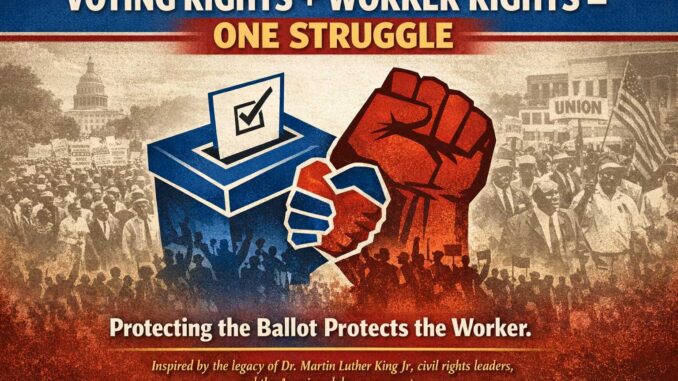
This struggle has always been intertwined with the labor movement. Labor Leaders played a major role in planning the 1963 March on Washington for Jobs and Freedom, mobilizing more than 40,000 union members, providing resources and lobbying for both the Civil Rights Act and the VRA. Once the VRA was enacted, it enabled thousands of successful cases against workplace discrimination and helped dismantle racist voting barriers across the South. As Black Voter turnout surged, so did worker power—particularly in Southern states where the VRA helped build multiracial, working-class coalitions.
The lesson is clear: Strong democracy strengthens working people, and when democracy weakens, workers pay the price.
That erosion began in earnest in 2013 when the Supreme Court’s Shelby County v. Holder decision struck down the formula requiring states with histories of racial discrimination to obtain federal approval before changing voting laws. States immediately began closing polling places, shortening early voting, and passing restrictive ID Laws—measures that disproportionately harm young people, shift workers and communities of color, the same groups driving today’s labor organizing efforts. Since Shelby, wages for Black teachers, city employees and health care aides have declined, while corporate power has expanded.
Democracy relies on rules that keep it fair—and some in power are working to erase those rules entirely. But America’s unions have never accepted a world where working people are silenced. The Labor Movement fought for the Voting Rights Act because we understand that the fight for fair pay, safe workplaces and dignity is inseparable from the fight for the ballot box.
Workers built this democracy, and workers will defend it. We will continue pressing Congress to pass the John R. Lewis Voting Rights Advancement Act to restore and protect Voting Rights and ensure free and fair elections. Voting Rights are a labor issue—because when democracy breaks down, worker power breaks down with it.
Recommended For You.


Be the first to comment