
Data News Staff Edited Report
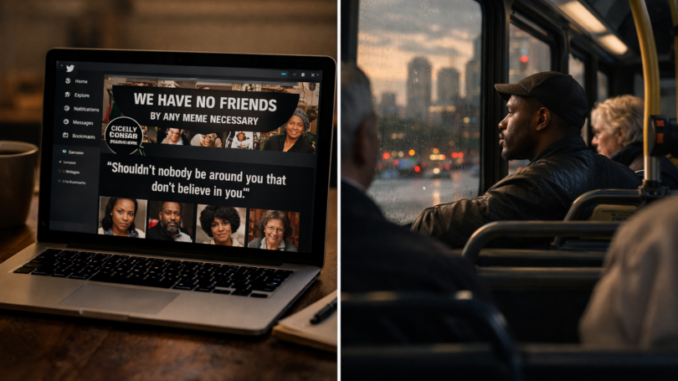
The phrase at the center of it all is blunt and unadorned: We have no friends.
By the end of 2025, the effort to thin Black memory had become impossible to ignore. Books quietly vanished from classrooms. Diversity, equity, and inclusion programs were dismantled through policy memos and procedural language. Affirmative action was reframed as indulgence rather than remedy. Even the words used to describe history were softened, shortened, or erased. The message was clear: forget faster, ask less, expect little.
At the same time, racism grew louder and less coded. It moved freely through politics and public discourse, shielded by claims of neutrality, tradition, or order. For many Black Americans, the moment called for something older than outrage. It called for documentation.
That is where this story begins.On X, an account titled “We Have No Friends / By Any Meme Necessary” appeared without announcement. It did not explain itself. It simply posted. Screenshots, short statements, cultural references—history compressed into humor sharp enough to carry warning. The account operates like a living archive, collecting what is ignored or dismissed and placing it back into view with precision rather than apology.
The phrase anchoring the account is not performative. We have no friends is offered as observation, not shock. In 2026, Black Americans do not require instruction on awareness. The posture is inherited. You read rooms. You read silences. You know which spaces merely tolerate you and which wish you gone. The account mirrors that understanding.
One post reads, “Shouldn’t nobody be around you that don’t believe in you.” It spread because belief has always been the dividing line. History has shown how quickly support dissolves once consequences appear. Survival has long required discernment.
Another post follows: “Silence after disrespect isn’t weakness. Some people don’t deserve a response.” That is not retreat. It is strategy.
The thread moves fluidly between past and present. Names like Sandra Bland appear without explanation, because none is needed. A traffic stop. A jail cell. A death without resolution. Her name remains a warning that compliance does not equal safety.
The account also preserves cultural memory—artists, elders, and builders whose contributions shaped Black life beyond policy debates. Their remembrance is not nostalgia; it is testimony. It asks who is remembered, who is honored, and who is quickly moved past.
Taken together, the account functions as resistance through record keeping. A refusal to let memory be edited down. A refusal to let culture be flattened. A refusal to allow erasure to proceed quietly.
The name says it plainly. Not isolation—but recognition.
In 2026, Black America understands that attention is not allegiance and proximity is not protection. It remembers who stayed and who disappeared. It builds when denied. It laughs when possible. It remains alert always.
And it keeps repeating the rule history has never disproved.
Recommended For You.

Be the first to comment