
Edwin Buggage
Editor-in-Chief New Orleans Data News Weekly
A Familiar Battleground
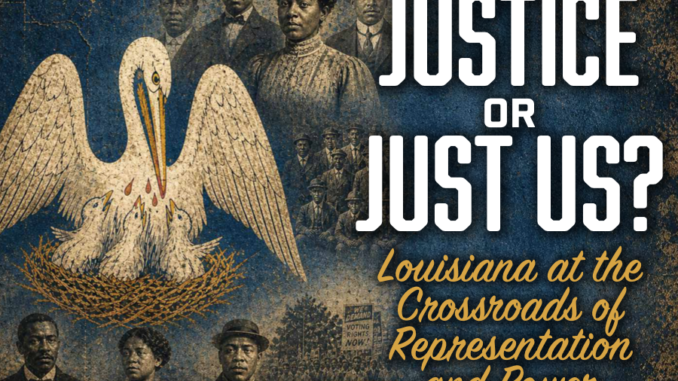
As voters are presently heading to the polls, once again, Louisiana finds itself at the center of a national conversation about race, power, and political representation. From congressional redistricting fights to local governance disputes, the state has become a flashpoint for debates over whether Black Voters—who make up a 33% of the state’s population—are being fairly represented in the political process. Civil Rights Advocates argue that ongoing legal battles over district maps are not just technical disputes, but fundamental questions about whose voices count in a democracy.
Redistricting and Representation
At the heart of the conflict are efforts to redraw political maps that determine how communities are represented at the State and Federal Levels. Critics say proposed maps dilute Black Voting Strength, particularly in regions where African American Populations could support additional majority-Black Districts. Supporters of revised maps argue they reflect broader political realities. But for many residents and advocacy groups, the issue is clear: representation should mirror the people, not suppress them.
Legal challenges have placed Louisiana under National Scrutiny, with courts weighing whether current district lines violate protections under the Voting Rights Act. The outcomes of these cases could have far-reaching implications, not only for Louisiana but for other states grappling with similar issues.
Rhetoric and the Political Climate
This election cycle has also been marked by a rise in conservative rhetoric that critics describe as increasingly xenophobic and divisive. Campaign messaging has focused heavily on immigration, crime, and cultural identity—often in ways that, opponents argue, inflame fears and deepen racial and social divides.
Political Analysts note that such rhetoric can shape voter perceptions and policy priorities, sometimes at the expense of nuanced discussions about economic opportunity, education, and public safety. For many voters, the tone of the current political climate raises concerns about whether the state is moving toward inclusion or further polarization.
New Orleans in the Crosshairs
New Orleans, long seen as a cultural and political stronghold for Black Leadership, has increasingly found itself at odds with state-level leadership. From debates over local governance authority to disagreements about crime policy and funding, tensions between the City and the Republican-Controlled State Government have intensified.
City Leaders and Community Advocates argue that these actions amount to an erosion of local control, disproportionately affecting a majority-Black City with a unique cultural and political identity. State Officials, however, maintain that their actions are aimed at improving accountability and public safety across Louisiana. But these arguments ring of familiar political dog whistles of a shameful racial past mired in divisive rhetoric and racially unequal policies.
Echoes of Plessy v. Ferguson
For many observers, the current moment evokes historical parallels. Louisiana was the birthplace of Plessy v. Ferguson (1896), the Supreme Court Decision that upheld Racial Segregation under the doctrine of “separate but equal.” Though that ruling was overturned decades later, its legacy continues to shape conversations about race and justice.
Today’s battles over representation and equity, some argue, are modern iterations of the same struggle: ensuring that the law protects all citizens equally, not just in theory but in practice.
A Defining Moment
As Louisiana navigates these complex issues, the stakes are high. The outcome of ongoing legal battles, the tone of political discourse, and the balance of power between Local and State Governments will all help determine whether the state moves toward a more inclusive future—or remains mired in old divisions.
For voters, the question remains as urgent as ever: Is the system delivering justice for all, or just for some?
Recommended For You.


Be the first to comment