
Benjamin Bates
Data News Contributor
Supreme Court Decision Sparks Celebration and Concern
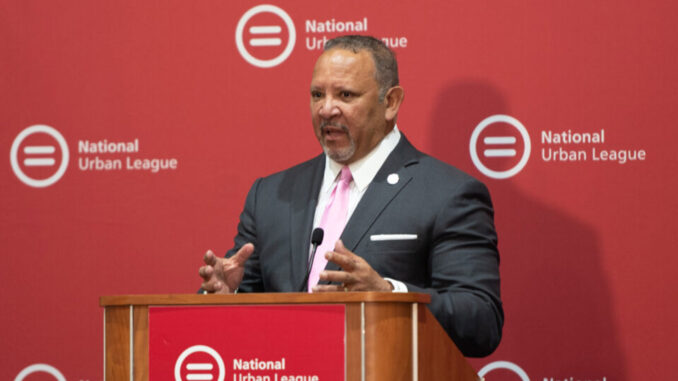
National Urban League President and CEO Marc Morial is praising the U.S. Supreme Court’s decision to reject an Executive Order that sought to limit birthright citizenship, while warning that the constitutional right guaranteed by the 14th Amendment could face future challenges.
In a commentary following the Court’s ruling, Morial called the decision an important victory for the Constitution and Civil Rights but cautioned that the narrow margin of the ruling should concern all Americans.
“While we applaud the Supreme Court for upholding the Rule of Law and recognizing the History of Black Americans in this country,” Morial wrote, “we are alarmed at the future dangers posed by such a narrow decision.”
Executive Order Targeted Birthright Citizenship
At the center of the legal dispute was Executive Order 14160, signed earlier this year, which sought to deny automatic U.S. Citizenship to certain children born in the United States to immigrant parents who were either in the country unlawfully or temporarily.
The order argued that the 14th Amendment does not universally Grant Citizenship to everyone born on U.S. Soil. Morial strongly rejected that interpretation, saying the policy was less about constitutional principles and more about expanding deportation efforts.
“The true goal,” he wrote, “was to fast-track deportations by stripping citizenship from children born to immigrants who contribute to this country while pursuing citizenship themselves.”
Morial also criticized what he described as inflammatory language surrounding immigration, accusing the administration of portraying immigrants as criminals while attempting to undermine long-established constitutional protections.
The Historical Importance of the 14th Amendment
Morial emphasized that the 14th Amendment holds profound significance in American History, particularly for Black Americans.
He noted that the amendment, ratified in 1868 after the Civil War, established citizenship for formerly enslaved people who had long been denied equal status under the law.
“America was founded by immigrants escaping persecution and built by enslaved people brought to this land against their will,” Morial wrote. “The same enslaved people who… were not considered American Citizens until 1868.”
According to Morial, efforts to weaken Birthright Citizenship ignore both the historical purpose of the amendment and the nation’s commitment to equal protection under the law.
Warning About Future Challenges
Although the Supreme Court blocked the Executive Order, Morial expressed concern over the narrow legal reasoning behind the decision.
He highlighted comments from Justice Brett Kavanaugh, who wrote that Congress could enact legislation establishing exceptions to Birthright Citizenship, even though no such law currently exists.
For Morial, those remarks signal that future attempts to limit Birthright Citizenship remain possible.
“While our movement and the Civil Rights community celebrate this week’s victory, we have been put on notice that another assault may soon be underway,” he wrote.
A Call for Civic Engagement
Morial also connected the ruling to broader concerns about voting rights and democratic participation.
He argued that efforts to restrict access to the ballot box and reduce political representation threaten the same constitutional principles at the heart of the Birthright Citizenship Debate.
In response, the National Urban League is expanding its Reclaim Your Vote Campaign ahead of upcoming elections while partnering with other Civil Rights Organizations to encourage greater civic participation and congressional action.
“This decision, and this moment in our history as we celebrate 250 years of the American experiment,” Morial concluded, “is a reminder that we all have a responsibility to this nation: to stand up in the face of tyranny and fight back with our voice and our ballot.”
For Morial, the Supreme Court’s Decision represents an important legal victory, but also a reminder that Constitutional Rights require continued vigilance, civic engagement, and public participation to ensure they remain protected for future generations.
Recommended For You.

Be the first to comment